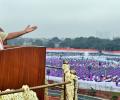
He made a reference to the clash between Indian and Chinese troops in Ladakh's Galwan Valley in June this year. "What our jawans can do, what the country can do, the world has seen in Ladakh," he said.
The infrastructure spending target for 2020-25 was revised because of additional and amended data provided by central ministries, state governments since the release of the summary NIP Report in December 2019 when it was pegged at Rs 100 trillion.
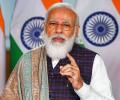
Modi said his government is carrying out "holistic reforms".

He further said that the "focus is on horizontal drilling" as rock formation has created challenges for vertical drilling.

Megha Engineering had emerged as the second-biggest buyer of electoral bonds and donated the highest amount of about Rs 586 crore to the Bharatiya Janata Party, according to the data released by the Election Commission on March 21.

'Russia is aiming at demoralising Ukraine as a nation.' 'They want to bomb the infrastructure, the electric stations so that regular citizens will not to be able to live, to cook, to give comfort to their kids.'

Through this 6-inch alternative lifeline, hot khichdi was sent to the stranded workers for the first time since they were trapped.
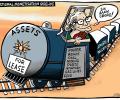
'This will have a multiplier effect in generating more jobs.'

15 to 25 per cent of property registrations in Mumbai come from redevelopment, with over 3,500 projects approved by May 2024.

'The force of reforms. The force of investment. The force of formalisation. The force of digital and green technology. And the force of youth and entrepreneurship. I am convinced that these 5 forces will propel India's rise over the next several decades,' predicts Kumar Mangalam Birla, chairman, Aditya Birla group.

Yes. Whilst public expenditure is kicking in, the key reason is the decline in private investment

Long-term funding was a requirement for infrastructure projects, and asset-liability mismatch in the banking system, impacts the access to finance for infrastructure projects. One of the key challenges would, however, be to get private sector back into investing.

Asserting that the self reliant India programme will help revive the global economy, Prime Minister Narendra Modi on Thursday told global business community that his government aims to transform the country through access, inclusion and empowerment while also ensuring complete data security. Addressing the World Economic Forum's online Davos Agenda Summit, where he also interacted with global business leaders, Modi also said India offers a predictable and friendly environment from tax regime to FDI norms. He said Aatmanirbhar Bharat movement is committed to global good and global supply chain while the country's digital profile has been completely transformed.

The world's third largest oil firm Royal Dutch/Shell has objected to state-run Gail India Ltd being made the sole agency to build the Rs 20,000 crore

All banks are eligible for privatisation. A committee of secretaries will decide which banks will be privatised, says Financial Services Secretary Debasish Panda.

India was among the top-five economies with the largest general government capital stock level, said, in 2015, an International Monetary Fund report called "Making Public Investment More Efficient". The report fuelled a debate on countries sitting on piles of cash that could be used better. India was believed to have public assets worth $4.5 trillion. The report urged countries to start asset recycling. Six years after the report, Australia's success in asset recycling has turned India into a believer; despite doing averagely in its previous efforts on roads, railways or meeting its divestment targets.

The government has fixed an indicative value for Delhi's iconic 'The Ashok' hotel at Rs 7,409 crore under the national monetisation programme, according to sources. The Ashok and the adjacent hotel Samrat are among the eight India Tourism Development Corp assets listed under the National Monetisation Pipeline (NMP) announced by Finance Minister Nirmala Sitharaman last year. The sources said investor consultation has already been undertaken and a cabinet note for the sale of the sprawling 25-acre property in the heart of the national capital is under consideration.

Infrastructure assets worth over Rs 1.62 lakh crore are expected to be monetised during the current fiscal, Parliament was informed on Monday. The government had last year announced a Rs 6 lakh crore National Monetisation Pipeline (NMP) to unlock value in infrastructure assets across sectors, ranging from power to road and railways in four years till 2025. In a written reply to the Lok Sabha, Minister of State for Finance Pankaj Chaudhary said about Rs 97,000 crore worth of public assets were monetised in the last fiscal (2021-22).
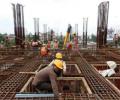
Around 576,000 housing units, worth Rs 4.64 trillion, are delayed in seven major cities of the country

Efforts to normalise trading relations expected during the first such meet on Saturday
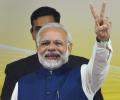
The document, shared by the prime minister on the occasion of the first anniversary of his second term on his Twitter account and web portal, detailed the steps taken by his government for the progress and development of the country. The document is divided into 15 heads ranging from ease of doing business, ease of living, to eliminating corruption and the country's fight against coronavirus.

The Indian economy is rapidly normalising towards pre-pandemic activity levels, even as uncertainty exists about coronavirus mutations and repeated infection waves, industrialist Kumar Mangalam Birla said on Wednesday. Vaccination is picking up pace, which would improve India's resilience against a potential third wave, the chairman of Aditya Birla Group said while virtually addressing shareholders at the AGM of group firm UltraTech Cement Ltd. Moreover, various steps taken by the RBI and the government have helped in containing the economic disruptions of the pandemic, Birla added.

'The wave of terrorism is over in Kashmir. Local people do not support it.'

The ministry of railways has dropped its proposal for monetisation of stations on public-private partnership mode, and projects are now being taken up under engineering, procurement and construction (EPC) mode, a source said. The source also told PTI that the ministry of railways has been asked to expedite monetisation of other assets, including trains, goodsheds, hill rail, stadiums, railway colonies and railway land parcels among others. "Largest asset class (stations) dropped. Stations earlier proposed on PPP mode are now being taken up under EPC mode," the source said.

Major General S C N Jatar, who passed into the ages on Monday night, thwarted anti-national forces at the peak of the Assam agitation. Colonel Anil A Athale (retd) salutes this officer and gentleman.

A six-inch pipe has been laid at the Silkyara tunnel through which nutritious food and medicines could be supplied to the 41 labourers, trapped for over a week after parts of the under-construction structure collapsed following a landslide.
Finance Minister Nirmala Sitharaman will present the much-awaited 2022-23 Union Budget on February 1. While there has been strong recovery in some sectors, touch services like hospitality, tourism and leisure continue to suffer after two Covid-19 waves. Household savings have been hit due to increased spending on health care. Consumption has still not reached pre-pandemic levels.

Prime Minister Narendra Modi on Wednesday said the government has no business to be in business and his administration is committed to privatising all PSUs barring the bare minimum in four strategic sectors. "It is government's duty to support enterprises and businesses. But it is not essential that it should own and run enterprises," he said. Modi also said the Centre's policy is to either monetise or modernise public sector enterprises, with the intent that the government has "no business to be in business".

'Interim Budget has ignited the entrepreneurial spirit.'

Reliance Industries, construction major L&T and IRB Infrastructure are some of the top companies that have used an infrastructure investment trust structure to reduce part of their debt and generate returns for their investors. Earlier this month, IRB Infrastructure InvIT was listed on the National Stock Exchange, giving its investors an option to exit by selling their units. The listing came within months of the Securities and Exchange Board of India's (Sebi's) guidelines for conversion of private unlisted InvITs into listed ones were issued.
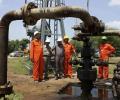
State-owned Oil and Natural Gas Corporation (ONGC) has cancelled the bids received for its Daman upside gas development project off the western coast due to high price quotes, sources said. The project is crucial to ONGC's strategy of ramping up gas production from its shallow-water fields off India's west coast. Once completed, the project would lead to nearly doubling of current gas production of 4-5 million standard cubic metres per day.

The stock of the country's largest passenger vehicle maker, Maruti Suzuki India (MSIL), has been hitting successive all-time highs over the past three trading sessions. The rally in the scrip has helped it notch over a 21 per cent gain since the start of February, outperforming the National Stock Exchange Nifty Auto Index. The gains for the leader of small passenger cars have been more recent, as the company still trails the Nifty Auto over one- and two-year periods.

While most experts suggest the government loosen its purse strings and not worry about the fiscal deficit in a pandemic impacted year, it will be a tightrope walk for the government to increase spending without going overboard.
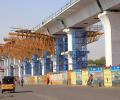
Investment in infrastructure was necessary for the economy, as power shortages, inadequate transport and poor connectivity affect overall growth performance, as per the Economic Survey 2019-20 tabled in Parliament by Union Finance and Corporate Affairs Minister Nirmala Sitharaman. "To achieve GDP of USD 5 trillion by 2024-25, India needs to spend about USD 1.4 trillion (Rs 100 lakh crore) over these years on infrastructure so that a lack of infrastructure does not become a constraint to growth," it said.
For development finance institution to succeed now, the government must stand like a rock behind it and be patient.

The immediate need is to put more money in the hands of agriculture-based and rural households to improve their purchasing power, says S Mahendra Dev.

The Budget emphasises on capacity building and empowerment of marginalised sections of society including farmers.

The second cyber attack on AIIMS took place just last fortnight, but the hospital's cyber security systems were able to successfully thwart this attempt.

India's production-linked incentive (PLI) scheme, which aims to make domestic manufacturing globally competitive, has attracted investment worth over Rs 45,000 crore and has also created three lakh jobs, NITI Aayog CEO Parameswaran Iyer said on Monday. The government has rolled out the scheme with an outlay of about Rs 2 lakh crore for as many as 14 sectors, including automobiles and auto components, white goods, pharma, textiles, food products, high efficiency solar PV modules, advanced chemistry cell and speciality steel. "The PLI programme has already started showing results.

The government has been waiting for the expansion by the private sector, Finance Minister Nirmala Sitharaman said while reminding India Inc of various measures including corporate tax rate cut, policy consistency, ease of doing business, among others to facilitate investment.
